
Introduction

With shifting interest rates, leaving cash in a standard bank account is costing you hundreds. Here is how to maximize yield on your emergency fund in 2026 using HYSA and CD ladder strategies.
Every percentage point counts when it comes to cash sitting in your bank account. If your emergency fund is still sitting in a traditional big-bank savings account earning 0.01% APY, you aren’t just missing out on interest, you are losing purchasing power to inflation.
The economic landscape in 2026 has shifted. While inflation has stabilized compared to the volatile early 2020s, the Federal Reserve has adjusted interest rates downward. This means that blindly parking money in the first High-Yield Savings Account (HYSA) you see on social media isn’t enough anymore. You need a deliberate strategy.
Here is how to optimize your cash reserve using a modern HYSA and CD strategy designed specifically for US consumers in this “new normal” rate environment.
1. High-Yield Savings Accounts (HYSAs): Still the Best Base Layer
HYSAs remain the gold standard for liquidity. The core function of an emergency fund is availability; if your car breaks down, you need that money today. Unlike certificates of deposit (CDs), an HYSA allows you to withdraw your money at any time without paying an early-withdrawal penalty.
Note: While rates are lower than their 2023 peak, top-tier HYSAs in 2026 still significantly outperform traditional checkings and savings.
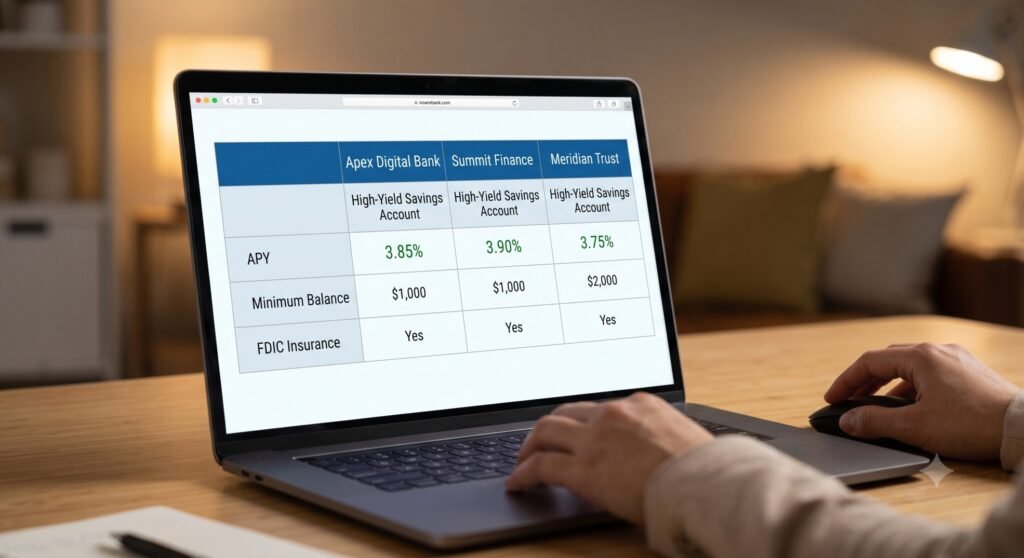
What to Look For Right Now
- Variable APY Margins: HYSAs feature variable rates that move alongside the Federal Funds Rate. Look for online banks that consistently stay in the top 10th percentile for APY rather than promotional introductory rates that drop after three months.
- FDIC or NCUA Insurance: Ensure the bank is backed by the FDIC (for traditional banks) or NCUA (for credit unions) up to $250,000 per depositor, per institution.
- No Monthly Maintenance Fees: Never pay a fee to hold your emergency fund.
Pro Tip: Keep your primary checking account at your traditional bank for daily branch access, but link it to an online HYSA. Transfers typically take 1–2 business days, which acts as a natural speed bump against impulse spending.
2. Lock In Yields with a Certificate of Deposit (CD) Ladder
Because HYSA interest rates are variable, they fall whenever the Fed cuts rates. If you have already built up a robust emergency fund (e.g., 6 months of expenses), leaving it ALL in an HYSA in 2026 means watching your interest income dwindle as rates drop.
If you want to lock in current yields for the next 12 to 24 months, a CD Ladder is the most effective strategy.
A CD ladder allows you to benefit from the higher interest rates usually offered by longer-term CDs, but keep a portion of your money accessible at regular intervals.
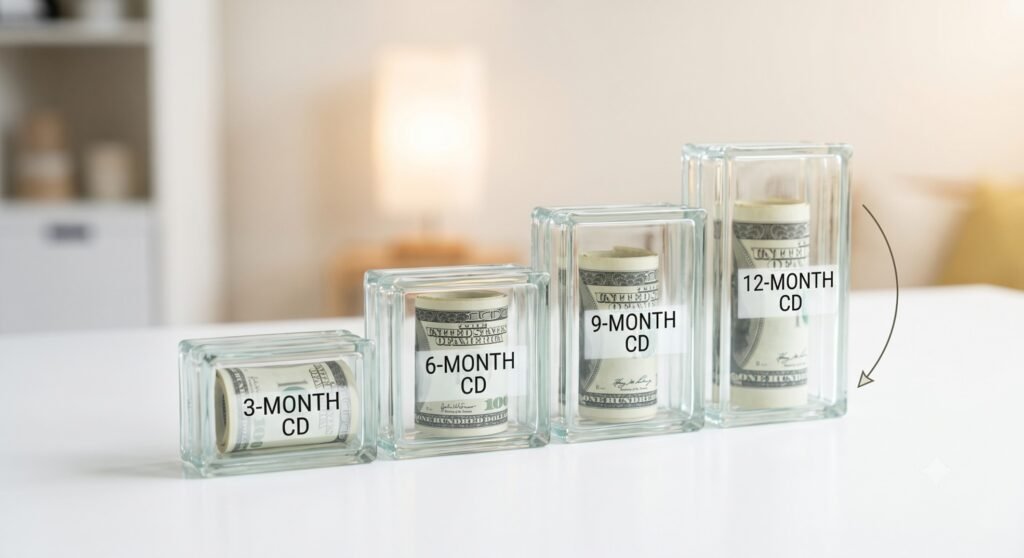
How a CD Ladder Works
Instead of depositing $10,000 into a single 1-year CD, you split your cash into equal portions across different maturity dates.
- Initial Setup: You might buy four CDs ($2,500 each) maturing in 3, 6, 9, and 12 months.
- The Rotation: When the 3-month CD matures, you take that $2,500 (plus interest) and reinvest it into a new 12-month CD.
- The Result: After one year of doing this, you will have a 12-month CD maturing every three months, providing guaranteed structure and regular liquidity.
3. Final Takeaway
Don’t let paralysis by analysis keep your money earning zero interest. If you are starting out, your first priority is maximization through an online HYSA.
Once you have established a cash cushion of 3 to 6 months of expenses, protect that yield. Setting up a basic CD ladder, perhaps starting with a simple 4-step structure, is a powerful way to guard your savings against the falling interest rates projected through 2026.